

Defining AI-Native Systems: Autonomy as Revision Authority
Editors’ note: “AI-native systems” is one of today’s most prominent tech buzzwords, yet its meaning remains ambiguous and often inconsistently defined. In this article, Professor Cheng Tan offers a technical perspective on what constitutes an AI-native system, providing both a clear definition and a systematic framework to help understand the technical evolution of AI for systems.

Slow Software: The Case for High-latency Systems Development
Systems research prizes efficiency and performance. For the last decade, I’ve worked on ultra-low-latency systems: the goal of Demikernel and its related nanosecond-scale systems (e.g., Cornflakes, Capybara) is to do more with fewer cycles. AI coding has brought the same level of efficiency to building systems, letting fewer programmers write more code. However, it has
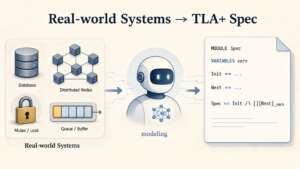
Can LLMs model real-world systems in TLA+?
Editors’ note: AI has been actively pushing the frontier of applied formal methods for computing systems. In this article, the Specula team wrote about their experience of evaluating LLMs on modeling system code, the basic capability for agentic model checking, using TLA+, a specification language for concurrent and distributed systems. The article is the 7th

The Long Game: How Agents That Remember Resolve Operational Issues Faster
Editors’ note: Self-Defining Systems is a new paradigm and a new research initiative at the University of Washington with the goal of leveraging the unique abilities of LLMs to accelerate infrastructure agility, while compensating and masking their weaknesses. It envisions a future in which infrastructure can design, validate, and evolve itself with minimal human intervention.

LDOS: Toward A Learning-Directed Operating System
Editors’ note: LDOS (Learning Directed Operating System) is among the most exciting expedition projects that showcase how AI could help revamp policies and mechanisms of modern operating systems (arguably the most important systems software). In this article (the fifth blog in The Next Horizon of System Intelligence series), the LDOS team shares their vision, roadmap, and

Let the Barbarians In: How AI Can Accelerate Systems Performance Research
Editors’ note: You must remember the widely discussed Barbarians at The Gate article that opened the The Next Horizon of System Intelligence series! For the fourth blog, we welcome back the ADRS team from UC Berkeley to share their recent work that demonstrates how to embrace and utilize AI (as the “barbarians”) to accelerate system performance